• Cart
  • Checkout
  • Shopping Cart Shopping Cart
    0Shopping Cart
Botanically Inclined - Seed Adventures
  • BASE CAMP
  • BLOG
  • Hepatica
    • Notes on Hepatica acutiloba
    • Notes on Hepatica americana
    • Named forms and collection numbers
    • Hepatica: Intermediate forms and cf. designation
    • Hepatica: Pollination, seeds & germination
    • Transplanting and caring for Hepatica seedlings
  • SEEDS SHOP
  • The Seeds Library
    • Caryophyllaceae
    • Liliaceae
    • Gentianaceae
    • Ranunculaceae
    • Orobanchaceae
    • Iridaceae
    • Primulaceae
    • Papaveraceae
    • Violaceae
    • Berberidaceae
    • Boraginaceae
    • Compositae
    • Caprifoliaceae
    • Fabaceae
  • Click to open the search input field Click to open the search input field Search
  • Menu Menu

The year of the Thistle

Alpine plants, Propagation

The beginning of the New Year has been busy with new seeds arrivals. Having a new garden space means also having new plants interests. Therefore, I declare 2016 as The Year of the Thistle!

According to wiki, “Thistle is the common name of a group of flowering plants characterized by leaves with sharp prickles on the margins, mostly in the family Asteraceae”. But besides the ‘true thistles’: Cirsium, Carduus and Onopordum, other genera that don’t have spiny leaves are also included and called thistles: Jurinea, Centaurea, Carthamus, Carlina, Rhaponticum, Echinops, Silybum, Berkheya and so on.

Few plants are more beneficial to bees, bumblebees and butterflies than thistles; also, many birds are consuming their seeds. Quite a few are cultivated as economical/medicinal plants. The oldest cultivated ‘thistle’ in the world was Carthamus tinctorius (safflower).

Unfortunately the name ‘thistle’ brings to mind mostly awful weeds. However, there are many species that are non-invasive and highly ornamental; some are even endangered in their wild habitat! To name only 2 North American Cirsium species that are not weedy and have become endangered: the endemic Cirsium hillii (C. pumilum var. hillii) – seen in the image, and C. pitcheri. Cultivated in the gardens but not too often is Cirsium canum (Queen Anne’s Thistle).

Cirsium hillii

Cirsium hillii growing under a Jack pine (P. banksiana)

A most interesting genus is Jurinea. These are species familiar mostly to plant collectors; the genus includes alpine/sub-alpine species growing in mountain meadows, a few rare and/or endemics. In the image is shown Jurinea mollis growing in a sub-alpine meadow in the Carpathian Mts.

Jurinea mollis in Carpathian Mts.

Jurinea mollis in the Carpathian Mts.

Other great species practically unknown in cultivation are Jurinea iljinii – with a restricted distribution range in the western part of the Greater Caucasus, and Jurinea sordida endemic in Crimea. They all have in common, non-spiny, finely lobed leaves and purple (in various shades) flower heads, which take on a beautiful silky appearance when the seeds are ripened.

Jurinea mollis seedhead

Jurinea mollis seedhead

There are also nice, low-growing Jurinea ssp. for the rock garden (if you can find seeds) like J. depressa and J. macrocephala, to name just a couple. From the low-growing thistles category, I will have to contend for now with the alpine thistle: Carlina acaulis. You can read more about it here.

Carlina acaulis

Carlina acaulis

To be continued…

Thistles gallery

Echinops
Swallotail on Cirsium
Berkheya purpurea
Jurinea iljinii seedlings
Cirsium canum seedlings
Carlina acaulis seedling
January 7, 2016
https://i0.wp.com/botanicallyinclined.org/wp-content/uploads/2016/01/Jurinea-mollis-flower-feat..jpg?fit=550%2C335&ssl=1 335 550 BotanyCa https://botanicallyinclined.org/wp-content/uploads/2013/04/logo-red-new2.jpg BotanyCa2016-01-07 19:59:442023-03-20 17:40:39The year of the Thistle

New territory – Pedicularis

Alpine plants, Mountains, Propagation

More seed adventures as I enter a new territory – that of the hemi-parasitic plants. Many beautiful and garden desirable species belong to this category, some not impossible to grow from seeds, most notably Castilleja spp. and Pedicularis spp. (Orobanchaceae, formerly Scrophulariaceae).
By coincidence, just after I collected a few Castilleja coccinea seeds, someone asked me if I would be interested in hemi-parasitic plants. And so, I got the chance to exchange it for Pedicularis oederi seeds ;)

Pedicularis oederi, Oeder’s lousewort, is an alpine species found in China, Japan, Russia, C and N. Europe (very rare in the Carpathian Mts.), and North America. Like many other Pedicularis spp., it has beautiful ferny looking foliage and it flowers for a very long time, producing yellow/crimson tipped flowers.

Pedicularis oederi

Pedicularis oederi – growing in the Carpathian Mts. at aprox. 2000 m alt.

Another Pedicularis that I am dreaming to grow one day is Pedicularis verticillata – whorled lousewort or Bumblebee flower, with whorled inflorescences of rich, purple-pink flowers. It grows in alpine tundra turf and rocky slopes from Japan, Russia, arctic C, N, and S Europe to NW America.

Pedicularis verticillata

Pedicularis verticillata with Bistorta vivipara in the Carpathian Mts.

An alpine meadow with Pedicularis verticillata in flower it is a sight to behold.

Pedicularis verticillata2

The good news is that most hemi-parasitic plants have a wide range of hosts and have been shown to germinate even without their presence. Various Pedicularis are parasitic on species of Poaceae, Ericaceae, Salix, Aster; but many others species have been also cited as hosts. Most notably, a study done on Bartsia alpina and Pedicularis lapponica found that both would form haustorial connections with Pinguicula vulgaris (Lentibulariaceae).

One method that is working somehow for these plants, involves the direct sowing outdoors – if you have something looking like a natural meadow, which I don’t. For my experiment, I split the P. oederi seeds in 4 portions. Even if I am not successful, I am sure I will learn something from it.

– Seeds sown by a gardening friend outdoors in the vicinity of an Erica plant.
– Seeds sown at our place, outdoors in the vicinity of Polygonum affine and Deschampsia caespitosa.
– Seeds sown together with Pinguicula vulgaris in a pot that will undergo cold/stratification outside over the winter.
– Few remaining seeds will be sown together with Carex grayi (a nice NA native sedge that can grow in full sun).

But there are many other wonderful Pedicularis out there! The excitement of a new territory…

Update 2016: I wasn’t succesful with any of the above,yet. Sometimes it takes 2 years for seeds to germinate so the ones in pots are not a lost cause. The ones sown in situ probably have been disturbed by the squirrels. More sowings have been done, this time only in pots in pieces of turf. One has to persevere :)

December 8, 2015
https://i0.wp.com/botanicallyinclined.org/wp-content/uploads/2015/12/New-territory.jpg?fit=600%2C234&ssl=1 234 600 BotanyCa https://botanicallyinclined.org/wp-content/uploads/2013/04/logo-red-new2.jpg BotanyCa2015-12-08 09:02:442023-03-20 17:40:40New territory – Pedicularis

Test, test – Eriogonum umbellatum var. porteri

Alpine plants, Plant portraits, Wildflowers of North America

Little plants series – the chameleon

It seems that my subscription form doesn’t always works, so I am testing with a little plant; actually from a category that should be better called ‘flat to the ground’ (or prostrate plants, botanically speaking ;) Eriogonum umbellatum (sulfur buckwheat), is well-known to the rock garden aficionados and mountain enthusiasts, and it has quite a few, hard to ID varieties.

E. umbellatum var. porteri (Porter’s sulphur flower) is the smallest of them all – a real golden nugget I acquired from Wrightman Alpines. In the wild it grows on rocky slopes and ridges at high-elevations in a few locations in Colorado, Nevada and Utah.

Eriogonum umbellatum var.porteri
Eriogonum umbellatum var. porteri – Bear in mind that this is a young plant and it needs a few more years to start glowing in its full splendour

Flat to the ground, or better said container, it is an all season interest plant: evergreen foliage with small leaves in tight rosettes, yellow bright flowers which turn red when fading (like in the featured image); the foliage will also acquire red and orange tones. Needless to say – pollinator friendly and a reliable, good companion for other little plants.

To make my point, two more images:

E. umbellatum var. aureum in full bloom in Wasatch Mts. (Utah), which is very similar with var. porteri; the later replacing var. aureum at higher elevations.

Eriogonum umbellatum var. aureum

Eriogonum umbellatum var. aureum (Wasatch Mts., Utah)

And an incredible old exemplar of E. umbellatum var. porteri which has turned red after pollination – growing at the Montreal Botanical Garden (which is renown, by the way, for its Alpine Garden).

Eriogonum umbellatum var.porteri - Montreal BG

Eriogonum umbellatum var.porteri ( Montreal BG)

Sort of a chameleonic plant I would say…

June 11, 2015
https://i0.wp.com/botanicallyinclined.org/wp-content/uploads/2015/06/Eriogonum-umbellatum-var.porteri-feat..jpg?fit=600%2C327&ssl=1 327 600 BotanyCa https://botanicallyinclined.org/wp-content/uploads/2013/04/logo-red-new2.jpg BotanyCa2015-06-11 11:08:072023-03-20 17:41:04Test, test – Eriogonum umbellatum var. porteri

Helleborus journeying

Alpine plants, Mountains, Propagation

A short break from the deep freeze allowed me to unwrap and check the plant trays stored in the garage today. Anxiety was running high because I had noticed that a few species had started to germinate more than a week ago. Luckily, from under two sheets of fleece and plastic, the Helleborus seedlings showed their happy faces :)

While I had never thought of growing Helleborus from seeds until last year, this has proven to be a very fruitful and satisfying journey so far. The seeds have germinated promptly after being sown fresh during late summer; also the storage in moist vermiculite turned out to be a very good option for extending the fresh seeds offering period.

Helleborus hybrid - double flower)

These Helleborus seedlings are descendants of mountaineer mother-plants:

Helleborus purpurascens

Helleborus purpurascens – a native of alpine meadows and forests in the Carpathian Mts. (Romania to Hungary)

The hybrid double Helleborus seedlings have ‘blood’ of Helleborus torquatus – a species confined to mountain regions of the former Yugoslavia (Bosnia, Croatia, Hertegovina and Serbia – where natural double forms can be found). The most desirable forms have deep violet purple flowers (H. torquatus is one of the parents of the first dark flowered Helleborus hybrids).

Double flower Helleborus torquatus

Double Helleborus torquatus

Just starting to germinate is also Helleborus foetidus, a native of mountain regions from Central and S. Europe. In many cases, Helleborus seedlings will start to flower in the second year, which is another reason to happily continue the journey. Even if not all of them will be garden worthy, there are endless chances to obtain new forms with different flower colours or traits. It will be a long time until the melting snow will allow us to enjoy the Helleborus flowering on this frozen land; until then we can rejoice in growing seedlings!

And to keep them company under the lights there is another mountain plant, this time a peony – Paeonia mlokosewitschii (a native of the Caucasus Mts.)

Paeonia mlokosewitschii seedlings

Paeonia mlokosewitschii seedlings

January 18, 2015
https://i0.wp.com/botanicallyinclined.org/wp-content/uploads/2015/01/Helleborus-purpurascens.jpg?fit=600%2C297&ssl=1 297 600 BotanyCa https://botanicallyinclined.org/wp-content/uploads/2013/04/logo-red-new2.jpg BotanyCa2015-01-18 14:40:372023-03-20 17:41:07Helleborus journeying

Rapunzel’s flower – Phyteuma

Alpine plants, Gardens, Plant portraits, Propagation

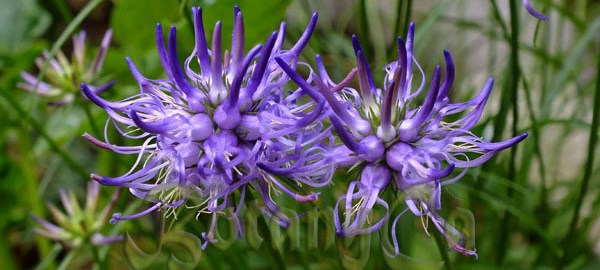
People in Europe call this member of the bellflower family (Campanulaceae) after many names: devil’s claws (Germany), Oxford Rampion (England), Raponzolo (Italy), and so on. We could definitely give it many other common names; I like to think of it as Rapunzel’s flower.

Phyteuma is strictly a European genus with quite a few species, not very often seen in the gardens. Phyteuma scheuchzeri, flowering now in one of my rock-containers is the most common in cultivation (I was aiming for P. sieberi, maybe next time…).

Phyteuma scheuchzeri

Phyteuma scheuchzeri

It doesn’t look like a bellflower, that’s for sure – it looks much cooler! In Phyteuma species the flowers are grouped in spiked, ball-like inflorescences (aka. floral sea creatures :-) which at full bloom ‘explode’ becoming fluffy. They can be found growing in a variety of habitats, with P. sieberi being the most alpine.

Phyteuma scheuchzeri

Phyteuma scheuchzeri

Another mountain growing Rapunzel’s flower is Phyteuma orbiculare, photographed here in a rich sub-alpine meadow in the Carpathian Mountains:

Phyteuma orbiculare

Phyteuma orbiculare

 Propagation: easy enough from seed (very small, fine seeds just like Campanula, sow superficial); most are warm germinators.

And just because I like word rhymes: Did you know that Phyteuma has a sister named Asyneuma? Another great but very little cultivated member of the bellflower family.


June 24, 2014
https://i0.wp.com/botanicallyinclined.org/wp-content/uploads/2014/06/Phyteuma-scheuchzeri-feat..jpg?fit=600%2C316&ssl=1 316 600 BotanyCa https://botanicallyinclined.org/wp-content/uploads/2013/04/logo-red-new2.jpg BotanyCa2014-06-24 08:22:342024-06-13 14:37:58Rapunzel’s flower – Phyteuma

In praise of little plants I

Alpine plants, Gardens, Plant portraits, Propagation

Plants that did make sense to have in my small garden

A dwarf, big flowered blue columbine: Aquilegia discolor, most probably a cross (from Seedex as A. saximontana)

Aquilegia discolor (cross)

 Aquilegia discolor cross

True that if we would grow only ‘reasonable’ plants, our gardens would lack all spontaneity and wonder. But because I can now easily enjoy them in containers, and not worry about their relocation, I think a bit of praise is warranted.

On the other side of the container, a tiny hardy ginger: Roscoea tibetica (from Lost Horizons) – very precious, after the bad winter we had, who knows if I will get to see the other Roscoeas from the garden.

Roscoea tibetica

Roscoea tibetica

From another container, the most fragrant, fringed Dianthus I know: Dianthus petraeus (from wild collected seeds in the Carpathian Mts.) Too bad I cannot insert a ‘scratch patch’ with its perfume.

Dianthus petraeus

Dianthus petraeus

A rock jasmine: Androsace sarmentosa – a small piece I saved from an old plant, I hope it will thrive again (or set seeds, or better both).

Androsace sarmentosa

Androsace sarmentosa

and more are on their way to flower…

June 5, 2014
https://i0.wp.com/botanicallyinclined.org/wp-content/uploads/2014/06/Dianthus-petraeus-featured.jpg?fit=550%2C339&ssl=1 339 550 BotanyCa https://botanicallyinclined.org/wp-content/uploads/2013/04/logo-red-new2.jpg BotanyCa2014-06-05 10:01:402023-03-20 17:41:36In praise of little plants I

Wrightman Alpines Nursery – Hello to a New Adventure!

Alpine plants, Gardens

The not so recent news from our small Canadian horticultural world is that Wrightman Alpines, a premiere alpine plants source from Ontario, is relocating to St. Andrews, New Brunswick. Fortunately, there is nothing to worry about as the mail-order will go on as usual, therefore, rather than saying goodbye, this is more a Hello to a new adventure!

Native alpine plants, little known plants, impossible plants…

Clematis columbiana var. tenuiloba, Matthiola trojana and Eritrichium howardii

Clematis columbiana var. tenuiloba
Matthiola trojana
Matthiola trojana
Eritrichium howardii

But for the few of us lucky to be able to drive for their open days last weekend, it was the moment to say goodbye and to wish them all the best in this new adventure of relocating their family and nursery in a new place. After operating for more that 25 years from this location, this is without doubt a courageous endeavour and needless to say heartbreaking because parts of the rock gardens, including plants will have to be left behind.

 One more look to the gardens and Hello to a New Adventure!

  • Adonis vernalis
Previous Previous Previous Next Next Next
123456789

 As soon as I’ll sort out the pictures we’ll have a last walk throughout the hoop-houses – the list of plants for my future rockery keeps growing longer…

And in the gardens last year

Previous Previous Previous Next Next Next
12345


May 20, 2014
https://i0.wp.com/botanicallyinclined.org/wp-content/uploads/2014/05/Daphne-featured.jpg?fit=600%2C338&ssl=1 338 600 BotanyCa https://botanicallyinclined.org/wp-content/uploads/2013/04/logo-red-new2.jpg BotanyCa2014-05-20 11:24:502023-03-20 17:41:57Wrightman Alpines Nursery – Hello to a New Adventure!

In sync – Corydalis solida

Alpine plants, Gardens, Photography, Plant portraits

Corydalis from the Greek ‘Korydalís’ meaning ‘crested lark’

Someone lucky enough to go hiking in the Carpathian Mountains in late April-early May would be surrounded by multicoloured masses of Corydalis solida – Fumewort (or ‘brebenei’ in my native tongue). There is a great variation in flower colour from white to pink and purple and actually the best forms of C. solida on the market today trace back their origins to Transsilvania (Romania) and Penza regions (western Russia).

This year, in sync, the ones from our garden are blooming at the same time:

Corydalis solida 'George Baker'

The renown Corydalis solida ‘George Baker’ (from Gardenimports – I am not really sure if it is the real thing but still a good red form)

Corydalis solida 'George Baker'3 An ephemeral at superlative – it appears fast with the temperature raise in the spring, and then disappears quietly after a few weeks. But for the brief time when it flowers, it will fill your heart with unconditional love for the years to come. The deeply divided ferny foliage and long spurred, tube-shaped flowers are adorable providing the much needed burst of colors after our long winters.

C. solida purple

Corydalis solida – in its usual purple form (from Lost Horizons)

Corydalis solida

They also make for very good photo-subjects after rain

C. solida ‘Beth Evans’- is a large-flowered form, with pink flowers; slow to increase.  They are very delicate when in active growth; to be moved, mark their place and lift up the small tubers (bulb-like) as soon as they go dormant or in the fall.

Corydalis solida 'Beth Evans'

Corydalis solida ‘Beth Evans’ (from Fraser Thimble Farm)

Due to its ephemeral nature it is offered mostly by specialized nurseries/mail-order operations. For part shade and moist conditions when in growth, then it prefers to remain on the dry side for the rest of the season. I particularly like them planted close to ferns or  ornamental grasses where they fill in the space just perfectly in early spring. They interbreed easily and will seed around if happy forming multicolored colonies.

Best not to be a purist when it comes to Corydalis solida!

This is just a small glimpse of the Corydalis solida world – there are many other named varieties. I already wrote about other wonderful Corydalis species – do not be afraid to become a corydaphill!

Note: If someone doesn’t know it, the absolut Corydalis guru and bulb expert is Janis Ruksans from Latvia – on-line catalogue here: Rare Bulbs
 
May 2, 2014
https://i0.wp.com/botanicallyinclined.org/wp-content/uploads/2014/05/Corydalis-featured-2.jpg?fit=600%2C376&ssl=1 376 600 BotanyCa https://botanicallyinclined.org/wp-content/uploads/2013/04/logo-red-new2.jpg BotanyCa2014-05-02 11:08:452023-03-20 17:41:59In sync – Corydalis solida

The Forgotten Forest – Polylepis

Alpine plants, Botanical travels, Mountains

A recount of our trekking trip on the Inca trail to Machu Picchu – part II

We were just starting on the second day to eventually reach the highest point on the Inca Trail: Warmiwañusca Pass (in translation Dead Woman’s Pass) at 4265 m. But before getting there we passed through what’s called a ‘submontane, subtropical humid forest’ or strait said cloud forest. At some point, the trail was followed, sometimes on both sides, by small, contorted trees with a specific, flaked, cinnamon bark. You could feel it is something special and slow down a bit – it was like walking through an enchanted forest, from a fairy tale and hope it never ends!

Polylepis tunnel

Through a Polylepis tunnel on the Inca Trail

The genus Polylepis has 27 species of trees and shrubs with an Andean distribution (with 19 species in Peru) and belongs to the rose family (Fam. Rosaceae). All tree species in the genus Polylepis (Quenoa) are confined to the high tropical South American Andes Mountains, where they grow best at elevations between 3500 to 5000 meters! That’s why Polylepis is considered the highest naturally occurring arborescent angiosperm genus in the world!

Their contorted, twisted growth is due to the harsh environment they are growing in. Also the layered bark with lots of thin, reddish, exfoliating sheets and the congested disposition of the leaves on the branches are adaptations to the specific high altitude climate of the Andes.

Still under the Polylepis spell, you’ll feel that the climb becomes more arduous. But the scenery is ‘magnifique’ and there are lots of other plants you probably never saw. Some guides will be able to tell you a few of them, if not the proper identification can wait for later.

Such was the case of Brachyotum – a genus of shrubs endemic throughout the high elevations of tropical Andes. The one in the image, probably B. quinquenerve, has the most vivid deep violet flower colour. Who wouldn’t want it in the garden?

Brachyotum

Brachyotum spp. – on the Inca Trail (maybe quinquenerve)

Toward the highest point of the Inca trail: Warmiwañusca Pass, which is situated at 4265 m, we entered the vegetation zone called the ‘Puna’. It is mostly grassland with various species like Stipa, Festuca and Miscanthus (of which about 48 species! are reported above 3000 m). It is very windy and cold, and there is a foggy, mysterious aspect of the nearby mountain slopes.

Misty mountain
Misty mountain
Misty mountain
Bomarea aurantiaca
Bomarea aurantiaca
The trail towards Warmiwanusca Pass
Vue of the Huayanay snow peaks from Warmiwanusca
Some sort of Valeriana
still unknown
still unknown
Descending trail from Warmiwanusca

But when on the mountain, what comes up has to go down, so quite a steep descent follows next toward Pacasmayo valley. In some areas the trail becomes very wide, at times looking just like a weathered garden stone path; a very strange feeling knowing you are at 4000 m altitude in the Andes – walking through the Inca gardens in the mountains!

Incas Garden in the Andes

Incas Garden in the Andes

To be continued…


March 1, 2014
https://i0.wp.com/botanicallyinclined.org/wp-content/uploads/2014/03/Polylepis-forest-2-copy.jpg?fit=600%2C352&ssl=1 352 600 BotanyCa https://botanicallyinclined.org/wp-content/uploads/2013/04/logo-red-new2.jpg BotanyCa2014-03-01 10:29:192023-03-20 17:42:01The Forgotten Forest – Polylepis

A botanical trip to Chilean Andes – part II

Alpine plants, Botanical travels, Mountains
Caiophora coronata

Another awesome trip, that shouldn’t be missed if you are in the region, is towards Embalse de Yeso. This is an artificial dam with an amazing alpine style lake at about 2500 m elevation. The narrow, gravely road follows dangerously close to the lake edge so it’s best to keep your eyes on the plants growing on the other side (if you’re not the driver!).

Caiophora coronata, which belongs to another South American family: Loasaceae, is definitely one of the coolest plant that you’ll see here. This species has big bonnet-shape flowers arranged in a crown, hence its name; the leaves are pinnate, heavily dentate and the whole plant is covered by stinging hairs. Needless to say, it’s recommended to wear gloves if you want to get close to it. The next one, Tropaeolum polyphyllum can be quite a shock for everyone used with the annual nasturtium. It is a tuberous plant with trailing stems up to 50 cm long, sprawling over the rocks. Leaves are deeply cut, grey-blue with 5-9 (11) folioles. Flowers are produced in a great number and they are big, yellow-orange, with a spurred calyx. Another Tropaeolum growing there is the endemic Tropaeolum sessilifolium. Smaller in size and more compact, the flowers are a combination of yellow, around the calyx and pink on the corolla. Something looking like splashed dots of colours on the rocky, barren slopes it is usually Cruckshanksia hymenodon – a plant with a name that makes you check your spelling five times. The actual flowers are very small, yellow and are surrounded by lavender-pink bracts, supposedly with the role of attracting pollinators.

Vue from the car
Vue from the car
Vue from the car
Embalse Yeso
Embalse Yeso
Caiophora coronata close up
Caiophora coronata
Caiophora coronata
Caiophora coronata
Caiophora coronata
Cruckshanksia hymenodon habitat
Cruckshanksia hymenodon
Landscape
Landscape
Tropaeolum polyphyllum
Tropaeolum polyphyllum close up
Tropaeolum polyphyllum
Haplopappus
Haplopappus
Calceolaria hypericina

We did manage to see a rosulate Viola toward the end of our stay. We were somewhere close to Laguna de Teno and stopped at the view of a showy Rodophiala rhodolirion. This is an endemic Amaryllidaceae, about 15 cm tall, which is quite a sight because of the big white to deep pink flowers with red marks, appearing before the foliage. Climbing the slope to take pictures of it, I almost crushed a Viola subandina, an annual Viola with a small purplish rosette. There were just a few of them, not too showy to be honest, and the flowers already gone – you could actually see a few seeds in the capsule, but I didn’t care. At that moment, it was the feeling of discovery that mattered most.

Have a look at the Viola subandina and also at a few other awesome plant species:

Viola subandina
Viola subandina
Viola subandina with seeds
Rodophiala rhodoliron
Rodophiala rhodoliron pink
Rodophiala rhodoliron
Tropaeolum sessilifolium
Oxalis compacta
Oxalis compacta
Oxalis squamata
Oxalis squamata
Quinchamalium chilense


February 21, 2014
https://i0.wp.com/botanicallyinclined.org/wp-content/uploads/2014/02/Caiophora-coronata.jpg?fit=600%2C450&ssl=1 450 600 BotanyCa https://botanicallyinclined.org/wp-content/uploads/2013/04/logo-red-new2.jpg BotanyCa2014-02-21 16:01:412023-03-20 17:42:03A botanical trip to Chilean Andes – part II

A botanical trip to Chilean Andes – part I

Alpine plants, Botanical travels, Mountains


This is a recount of a trip we were lucky to make a few years ago in the Chilean Andes. At the time, I had developed a mild new obsession for the rosulate Violas after seeing a few pictures and reading about them on the Botany Photo of the Day and the Alpine Garden Society websites. Now, after a few years I got over it, nevertheless is was an exciting adventure into unknown, wild landscapes. We were lucky to be welcomed and drove around by our welcoming Chilean hosts, but otherwise Chile is a safe place to travel and modern amenities can be found almost everywhere, by comparison with other regions from South America.

Follow us please in the Chilean Cordillera where most of these plants are growing, trying to survive, on rocky, gravely, exposed slopes. High solar radiation, very little rain during the summer months and substantial snow cover in the winter form the main picture of their growing habitat. I like the sonority of the local name for this kind of sites – ‘rumbles’, and indeed in many places you expect the rocks to start sliding down any moment.

On the first trip towards Farellones, Valle Nevada and La Parva, well known sky resorts close to Santiago, on a narrow, steep road that winds through the Cordillera, we started to see the first Alstroemeria species, commonly called Lily of the Incas. Chile is one of the two centres of diversity for Alstroemeria with some 50 species among which about 80% are endemic! As many times the case, they have been widely used as a genetic source for creating new ornamental hybrids, often with Alstroemeria species from Brazil.

Alstroemeria exerens
Alstroemeria pallida
Alstroemeria umbellata
Landscape
Landscape
Landscape Farrelones
Schizanthus grahamii var. coccineus
Schizanthus hookeri
Schizanthus hookeri
Schizanthus hookeri close up

First to appear was Alstroemeria pallida. It flowers between November and March, and grows to about 60 cm tall, with 2-5 pink flowers arranged in an umbelliform inflorescence. The two superior tepals have a pattern of dots and stripes with a bright-yellow median band, that act as an advertising ‘banner’ for pollinators (nectaries guides). Alstroemeria exerens is not as abundant as A. pallida; only about 35 cm tall, has large, deep pink flowers with the same patterns on the two tepals, but with a wider yellow band. On the margin of the road towards Valle Nevada, close to the marks left by big trucks carrying construction materials, we found the low growing, unmistakable Alstroemeria umbellata. The leaves rosettes are somewhat fleshy with a bluish tone and the pink flowers are grouped in large umbelliform inflorescences.

In quite a few places groups of Schizanthus hookeri were forming lovely compositions with the California poppy (Eschscholzia californica) an introduced species there.  Schizanthus hookeri is an annual species in Fam. Solanaceae. What? – this was our reaction too, as it doesn’t resemble at all with our typical Solanaceae.  It is 30-80 cm tall with pinnate or bipinnate –sectate leaves and numerous purple to lilac flowers with a yellow median lobe.

The perennial Schizanthus grahamii var. coccinea (syn. Schizanthus coccineus) grows to 30-50 cm tall and has brightly coloured flower with a particular morphology: the lateral lobes are more or less divided, depending on the species and usually with the superior lobe of a different colour. Commonly called Mariposita, they have been taken into cultivation and most of the named varieties belong to S. x wisetonensis, known as the Poor man’s orchid or the Butterfly flower. In La Parva, situated at about 2800 m elevation, we looked around on some gravelly, slippery slopes after the rosulate Viola, which was supposed to be around but couldn’t find any. However, this lead to the discovery of other delicious small plants between the rocks, like Chaetanthera and Oriastrum chilense.

A few more interesting species from this region and more to follow in the next posts:


Chaetanthera
Chaetanthera
Chaetanthera
Calceolaria sp.
Calceolaria sp.
Laretia
Laretia
Laretia acaulis
Laretia acaulis
Laretia
Laretia
Calceolaria thyrsiflora
Montiopsis andicola
Montiopsis andicola
Montiopsis umbellata
Mutisia
Mutisia
Nastanthus
Nastanthus
Oenothera acaulis
Oenothera acaulis
Oxalis compacta
Oxalis compacta
Oxalis squamata
Oxalis squamata
Quinchamalium chilense


February 21, 2014
https://botanicallyinclined.org/wp-content/uploads/2013/04/logo-red-new2.jpg 0 0 BotanyCa https://botanicallyinclined.org/wp-content/uploads/2013/04/logo-red-new2.jpg BotanyCa2014-02-21 13:50:212023-03-20 17:42:04A botanical trip to Chilean Andes – part I

Rock treasures from Wasatch Mountains

Alpine plants, Mountains, Wildflowers of North America
Primula parryi detail

The nice thing about Snowbird is that if you are short on time, the Aerial Tram from the Snowbird Centre it will take you up to the Hidden Peak situated at 11,000 ft. in no time. This will give you plenty of time to take pictures and botanize around. From there, one option is to explore on the trail towards the East Twin Peak. The whole ridge looks like a crevice garden planted with species adapted to the harsh environment, all of them real rock treasures.

Crevice 'garden'

Among these, Hymenoxys grandiflora – Old Man of the Mountain (Asteraceae), is an alpine that cannot be missed. Flower stems range from a few inches tall to 10 inches and the big yellow flower heads, are said to face east almost always. Stems and leaves are dense hairy green. Phlox hoodii – Carpet or Hood’s phlox (Polemoniaceae), is a miniature phlox growing on dry, rocky slopes from mid to high-elevations. It forms compact clumps, 6 – 8 inches high, with white to lilac flowers. The leaves are sharply pointed and woolly pubescent. It blooms from May to July depending on elevation.  

Another very bright alpine plant, Eriogonum umbellatum – Sulphur flowered buckwheat (Crucifereae) – grows about 12 to 14 inches tall and has flowers that are cream to bright, sulphur yellow at the top of sturdy stems.  Leaves are glabrate, green above and pubescent beneath. Although very well known, we are always happy to meet Silene acaulis. The Moss campion (Caryophyllaceae)is usually the special reward for those who climb to the mountain tops, both in North America and Europe. It is a low, densely matted, cushion-like perennial generally less than 2 inches tall. The stems are woody and densely covered with short needle-like leaves. They flower from July to August producing a multitude of small pink blossoms.

Hiking down from the Hidden Peak, in the Little Cloud Bowl, there was still a lot of snow, but we rummaged between rocks and snow knowing that we must find there an elusive Primula: Primula parryi. Parry’s primrose (Primulaceae) is a rather rare alpine beauty that likes to have wet roots, so it is often found in snow-melt areas, alpine streamsides above 10,000 ft. elevation. The thick leaves are disposed in rosettes and supposedly have an unpleasant aroma (that we didn’t noticed). The flowers are a bright magenta colour with yellow centers, produced on a sturdy stem up to 12 inches tall.

Hymenoxys grandiflora
Phlox hoodii
Phlox hoodii
Eriogonum umbellatum
Rock 'garden'
Rock 'garden'
Primula parryi in habitat
Primula parryi detail
Primula parryi
Primula parryi
Silene acaulis
Silene acaulis
Androsace septentrionalis
Anemone multifida
Anemone multifida
Antennaria microphylla
Erigeron sp.
Erigeron sp.

A few other interesting alpines presented in the gallery: Androsace septentrionalis, Anemone multifida and Antennaria microphylla. But these are really just a few plant portraits from an area extremely rich in wildflowers, well worth of an alpine ‘escapade’ at the end of July or in August, when there’ll be probably more chances to collect some seeds too.

More plant images are presented in the next posts – Highlights from the Wasatch Mountains.


February 21, 2014
https://i0.wp.com/botanicallyinclined.org/wp-content/uploads/2014/02/Primula-parryi-detail-copy.jpg?fit=500%2C375&ssl=1 375 500 BotanyCa https://botanicallyinclined.org/wp-content/uploads/2013/04/logo-red-new2.jpg BotanyCa2014-02-21 09:42:562023-03-20 17:42:04Rock treasures from Wasatch Mountains
Page 2 of 3123
Search Search

Subscribe to Blog via Email

BotanyCa SEED List

Latest posts

  • Corydalis seeds sale, May-June 2026May 23, 2026 - 11:52 am
  • Corydalis seeds sale – coming up!May 21, 2026 - 3:53 pm
  • Welcome to May, 2026May 15, 2026 - 4:06 pm
  • Spring beauties #2May 2, 2026 - 1:23 pm
  • Spring beautiesApril 27, 2026 - 12:56 pm
  • In pink, blue and purpleApril 18, 2026 - 3:55 pm
  • Easter #2April 10, 2026 - 5:05 pm

Wildflowers of North America

  • Welcome to May, 2026May 15, 2026 - 4:06 pm
  • Spring beautiesApril 27, 2026 - 12:56 pm
  • Cold stratification – part 3, the practicalsJanuary 30, 2026 - 2:45 pm
  • July colorsJanuary 23, 2026 - 4:01 pm
  • Latest for OctoberOctober 31, 2025 - 1:47 pm
  • Moist packed seeds updateOctober 21, 2025 - 3:29 pm
  • Maple-leaved ViburnumSeptember 19, 2025 - 3:14 pm
  • Fall bountySeptember 16, 2025 - 4:03 pm
  • Diphylleia cymosa plant portraitAugust 15, 2025 - 2:22 pm
  • Waiting…raspberries and blackberriesAugust 2, 2025 - 4:09 pm
  • Native woodland garden recipe – updatedJuly 30, 2025 - 4:10 pm
  • Re-opening soonJuly 25, 2025 - 2:22 pm
  • Summer Seeds 2025June 25, 2025 - 1:50 pm
  • The ‘superfluous’ PenstemonJune 20, 2025 - 2:37 pm
  • Hepatica seeds sale 2025June 8, 2025 - 1:34 pm
  • Getting ready for HepaticaJune 5, 2025 - 3:10 pm
Follow us on Facebook

Just a few places I enjoy to stop by…

Plants of the World
Scottish Rock Garden Forum
Ontario Rock Garden Society
Acta Plantarum
iNaturalist
John Jearrard
macgardens.org
Prairiebreak
Plants and Rocks
Composer in the Garden

What’s in the Seeds Shop:

  • Annual and Biennial Plants
  • Aquilegia
  • Carnivorous Plants
  • Clematis
  • Corydalis & all
  • Fast Shipping
  • Gentiana & other gents...
  • Gift cards
  • Grasses & related species
  • Hepatica
  • Iris
  • Lilium and Fritillaria
  • Medicinal & Edibles
  • Moist-packed Seeds
  • Monocots
  • Orchids & other mycorrhizals
  • Paeonia
  • Primula and allies
  • Rock Garden Plants
  • Vines, Shrubs & Trees
  • Viola
  • Wildflowers of North America
  • Worldwide Plants

Subscribe to Blog via Email

Enter your email address to subscribe to this blog and receive notifications of new posts by email.

Contact
Shipping & Delivery
Germination Page
Canadian Badge
All content Copyright© 2012-2026 Botanically Inclined & BotanyCa
  • SEEDS SHOP
  • Ordering Info
  • Shipping & Delivery
  • Privacy Policy
  • Contact
Scroll to top Scroll to top Scroll to top

This site uses cookies. By continuing to browse the site, you are agreeing to our use of cookies. See our Privacy policy.

OK

Cookie and Privacy Settings


How we use cookies

We may request cookies to be set on your device. We use cookies to let us know when you visit our websites, how you interact with us, to enrich your user experience, and to customize your relationship with our website.

Click on the different category headings to find out more. You can also change some of your preferences. Note that blocking some types of cookies may impact your experience on our websites and the services we are able to offer.

Essential Website Cookies

These cookies are strictly necessary to provide you with services available through our website and to use some of its features.

Because these cookies are strictly necessary to deliver the website, refusing them will have impact how our site functions. You always can block or delete cookies by changing your browser settings and force blocking all cookies on this website. But this will always prompt you to accept/refuse cookies when revisiting our site.

We fully respect if you want to refuse cookies but to avoid asking you again and again kindly allow us to store a cookie for that. You are free to opt out any time or opt in for other cookies to get a better experience. If you refuse cookies we will remove all set cookies in our domain.

We provide you with a list of stored cookies on your computer in our domain so you can check what we stored. Due to security reasons we are not able to show or modify cookies from other domains. You can check these in your browser security settings.

Google Analytics Cookies

These cookies collect information that is used either in aggregate form to help us understand how our website is being used or how effective our marketing campaigns are, or to help us customize our website and application for you in order to enhance your experience.

If you do not want that we track your visit to our site you can disable tracking in your browser here:

Other external services

We also use different external services like Google Webfonts, Google Maps, and external Video providers. Since these providers may collect personal data like your IP address we allow you to block them here. Please be aware that this might heavily reduce the functionality and appearance of our site. Changes will take effect once you reload the page.

Google Webfont Settings:

Google Map Settings:

Google reCaptcha Settings:

Vimeo and Youtube video embeds:

Other cookies

The following cookies are also needed - You can choose if you want to allow them:

Accept settingsHide notification only