More snow is on the way for us (and bitter cold), but we are hiking on the Sooke Coast trail where there are many flowers ;) Enjoy and more to come…

As I mentioned in part 1, Sedum spathulifolium seems to enjoy the company of many other species: Triteleia/Brodiaea, Allium cernuum, Heuchera micrantha and Pentagramma, to note just a few. The contrast of its bluish rosettes with the violet flowers of Triteleia laxa was particularly exquisite.

Brodiaea coronaria

Triteleia laxa Brodiaea coronaria – corrected thanks to a SRGC forumist, grows from a small, edible corm (Fam. Asparagaceae) and flowers usually after the foliage dies back. Flowers can be light blue to violet, rarely white; especially attractive when growing in groups, with the flowers showing up among the golden, dry foliage.

Another Triteleia species encountered was Triteleia hyacinthina (fool’s onion). The plant can be variable in height (10-40 cm) and has compact umbels of white flowers (sometimes having bluish tints) with green midribs. I don’t know really know if to call this one Brodiaea…

Triteleia hyacinthina

Triteleia hyacinthina close-up

Allium cernuum, the nodding onion, was also found growing nearby and looked very attractive when drooping gracefully over a rock ledge.

Allium cernuum

Taking pictures of Triteleia, I noticed something glittering in the sun down the slope and approaching to see better, I noticed the goldback fernPentagramma triangularis. This lovely small sized fern can remain evergreen throughout the year when enough moisture is available.  In full sun and dry conditions, as I found it, it will curl its fronds and reveal the golden spores. I know the picture cannot show the reality of the ‘golden glitter’, but it’s true. What a great little fern for the rock garden!

Pentagramma triangularis – Goldback fern on Sooke Coast Trail

Meandering around beach pockets, the hiking trail enters sometimes into the forest (there is also an option to return through the woods to the trailhead). Majestic Douglas, Tsuga, Sitka spruce and Thuja plicata will accompany the path; it’s only after the bark that you can tell which one is which. A spectacular shrub encountered in large numbers as an understory, was the salal, Gaultheria shallon (Fam. Ericaceae).

Gaultheria shallon – Salal

This is an evergreen shrub, 1,5 m to 3 m tall, which can form very dense thickets. The leathery, thick leaves and the racemes of urn-shaped, white to pink flowers make it for a very handsome shrub. Fruits are purplish-black berries that are said to be sweetish and flavourful. Salal berries were a staple food for the NW coastal First Nations, who use to eat them preserved in oolichan (bear fat – correction thanks to a  sharp eye, oolichan or smelt is a fish – see end of the post for more info), pounded and dried into cakes (kept in woven baskets over the winter). There is also mention of mixing the fruits with salmon eggs to obtain a sweetish dish…

Gaultheria shallon


Excerpt
read more here – Eulachon, Oolichan, Candlefish, Hooligan 

“To Native Americans, the return of the eulachon meant the beginning of spring and a renewed food supply, literally saving lives and earning them the name “salvation fish” or “savour fish.”  They were the first fish to arrive in the river after a long cold winter when most of their stored food supplies had been depleted.   Unlike other fish oils, eulachon lipids are solid at room temperature, with the color and consistency of butter.  These fish are almost 20 percent oil by weight, allowing a fine grease to be rendered from their bodies and creating a high-energy food source that could easily be transported and traded with other tribes farther inland.”


Sooke Coast Trail – part 1

At this time of year we are in need of sunny/flowery images, so I’ll quit the propagation stories for a while (I am sure some readers got heavily bored ;). Chance made it that I got to visit Victoria (situated on the southern part of Vancouver Island) in late May, but never got to sort through the many pictures; few posts will take care of this now ;)

A short note for those who are not familiar with the region: the southern part of Vancouver Island constitutes the northern growing limit for many species, which are common otherwise on the US west coast down to the Californian coastal mountains. Victoria is considered the mildest city in Canada and enjoys a sub-mediterranean climate (yes you hear me well!) with mild winters (snow is a very rare event), rainy springs and falls and dry summers (hardiness considered, zone 7-8).

The first highly recommended hiking destination, in a short driving distance from Victoria, is the Sooke area. There are a few trails available, which can be done partially or entirely. The Coast Trail in East Sooke Regional Park was particularly impressive (follow link to see map and read more).

view-from-sooke-coast-trail-2

View from Sooke Coast Trail

Excellent views are opening all along the trail, which follows the rocky coast, only with a few passages going deep into the forest (usually to go around a pocket beach). In between taking pictures and stopping to admire the wild, rugged landscape, time flies; I would say that at least two days are necessary to get a good grasp of its beauty.  It is very hard to choose only a few pictures to show.

view-from-sooke-coast-trail

View from Sooke Coast Trail

Plants speaking, the first species that makes you go – WoW! Is the Pacific Madrone – Arbutus menziesii. Any time I encounter in the wild a species previously known only from picture, there is a special feeling, same like meeting a person known previously only from correspondence. I couldn’t shake hands with the Arbutus :) but I was happy to brush my hand over the exquisite cinnamon/red, exfoliating bark.

arbutus-menziesii

Arbutus menziesii on Sooke Coast Trail – Pacific Madrone, Arbutus

Pacific Madrone/Arbutus is an evergreen tree with many other qualities, glossy leaves and creamy clusters of flowers (attracting many pollinators) followed by red fruits; all making for a most beautiful tree. And there is more – the trunk and branches are twisting in various ways, to the point that sometimes they will hug and gracefully slide along the rocks’ contour. Its native range extends from:  SW  Vancouver Island to south Baja California. It is found growing in dry open forests, rocky slopes, on coarse or shallow soils.

arbutus-menziesii-1

Arbutus menziesii

Another ‘staple’ species of the region is Sedum spathulifolium – the broadleaf stonecrop. It seems able to grow absolutely everywhere: on moss-layered rocks, decomposed tree trunks, wind blasted rocks in full sun or cascading over shaded boulders. Truly spectacular! Probably half of my pictures contain this Sedum in various plant-associations. I liked it best together with Cladonia or a Cladina sp. (the reindeer moss); the white-silvery, lacy lichen bringing out the beauty of the bluish foliage and the contrasting red stems & yellow flowers.

sedum-spathulifolium-sooke-4

Sedum spathulifolium and reindeer moss on Sooke Coast Trail

sedum-spathulifolium-sooke-3

Sedum spathulifolium 

sedum-spathulifolium-sooke-7

Sedum spathulifolium tumbling over the rocks

This post is getting a bit too long so more to follow…

Update: since I wrote this post in 2014! we now have the plants grown from wild collected seeds in the Carpathian Mts. (2 different accessions) flowering well and rewarding us with seeds. Nothing is more satisfying than to see plants grown from few seeds found by chance  growing well in the garden. This species is increasingly rare in the wild; growing it in the garden it is also a matter of conservation at this point. The greenish-slate gray with back dusted purple flowers are exquisite! not to mention the foliage.


I am not young enough to know everything” – Oscar Wilde

A quick post because I just ‘discovered’ that Helleborus purpurascens seeds are best sown fresh in the summer. They need to go through a warm-moist period followed by cold-moist in order to germinate best. Older seeds will still germinate but in a lower percentage. Helleborus is one thing I have never done from seed (members of Ranunculaceae are notoriously difficult germinators). This is a rare Helleborus species distributed only along the Carpathian Mountains range, up to central and northern Hungary. Interestingly, it can be found growing in full sun, in open alpine meadows and also under dappled shade in beech woods.

Helleborus purpurascens in native habitatHelleborus purpurascens growing in full sun in native habitat – Carpathian Mts.

Graham Rice, the authority in all Helleborus matters, has an extensive article on H. purpurascens on his website, you can read it HERE. In a bit of a hurry, I will quote him so no one can say I am biased because of its origins:

It is “one of the most captivating species for its engaging habit of flowering so enthusiastically, for its subtle metallic tints… The foliage too is unlike that of other hellebores, in that it radiates from the tip of the petiole in a neat circle.”

As for the flowers, a few forms that are known from Botanical Gardens: are purple in colour with dark veins, slightly pinkish towards the base and netted towards the edge; some flowers have an overall green haze…In a second form which reaches 15 in in height the flowers are smoky blue-purple in colour, darker outside than in, with slightly reddish veins inside and green nectaries. Other forms may be slate purple or deep purple outside, shining pinkish shades….”

Helleborus purpurascensHelleborus purpurascens – from what’s left it seems matching the description!

A truly collector’s plant, so this is a call for a seeds trade – if someone wishes a few fresh Helleborus purpurascens seeds to sow them right away, please get in touch with me here, on my email or at infoATbotanicallyinclined.org (of course replace AT with @

It would be a pity not to have them all germinating well – still enough summertime left!

Helleborus purpurascens seedsHelleborus purpurascens seeds


Alvar is the name used for a distinctive habitat formed by a thin covering of soil or no soil at all, over a base of limestone or dolostone bedrock. These alvars support specialized species communities and are found only in the North America Great Lakes Basin, Estonia, Sweden, Ireland and UK. Ontario contains 75% of the alvars in North America.

Campanula rotundifolia and Packera paupercula

Campanula rotundifolia and Packera paupercula

I find the extreme conditions in which plants can grow in the alvars, especially the open pavement and shoreline alvars, quite fascinating. Pools of water collect in slight depressions in the surface of the rock ‘pavement’ after rain and spring snow melt, and then small amounts of silt and sand accumulate and provide a habitat for plants to take root in the shallow holes, grikes and joint fractures shaped by water erosion. The reason I found the alvars and the plants growing there so fascinating is that they remind me of a rock garden situation, a really though one, with little soil and rooting space for the plants, high temperatures in the summer and more than this with high variation on the moisture levels throughout the seasons.

Many of the alvar plant species are perennials, of which some are more or less confined to this particular environment. For example species like Cirsium hillii, Solidago ptarmicoides and Astragalus neglectus have a high alvar confinement (above 70%), while others like Zigadenus elegans have a low<50 % alvar confinement. Besides knowing and protecting them, the ability to grow in such conditions it is a proof of their adaptability and more of them should be tested into cultivation.

The following images have been taken in the Bruce Peninsula area, in Ontario – it is a gallery that gradually it will be updated with more species.

A recount of our trekking trip on the Inca trail to Machu Picchu – part II

We were just starting on the second day to eventually reach the highest point on the Inca Trail: Warmiwañusca Pass (in translation Dead Woman’s Pass) at 4265 m. But before getting there we passed through what’s called a ‘submontane, subtropical humid forest’ or strait said cloud forest. At some point, the trail was followed, sometimes on both sides, by small, contorted trees with a specific, flaked, cinnamon bark. You could feel it is something special and slow down a bit – it was like walking through an enchanted forest, from a fairy tale and hope it never ends!

Polylepis tunnel

Through a Polylepis tunnel on the Inca Trail

The genus Polylepis has 27 species of trees and shrubs with an Andean distribution (with 19 species in Peru) and belongs to the rose family (Fam. Rosaceae). All tree species in the genus Polylepis (Quenoa) are confined to the high tropical South American Andes Mountains, where they grow best at elevations between 3500 to 5000 meters! That’s why Polylepis is considered the highest naturally occurring arborescent angiosperm genus in the world!

Their contorted, twisted growth is due to the harsh environment they are growing in. Also the layered bark with lots of thin, reddish, exfoliating sheets and the congested disposition of the leaves on the branches are adaptations to the specific high altitude climate of the Andes.

Still under the Polylepis spell, you’ll feel that the climb becomes more arduous. But the scenery is ‘magnifique’ and there are lots of other plants you probably never saw. Some guides will be able to tell you a few of them, if not the proper identification can wait for later.

Such was the case of Brachyotum – a genus of shrubs endemic throughout the high elevations of tropical Andes. The one in the image, probably B. quinquenerve, has the most vivid deep violet flower colour. Who wouldn’t want it in the garden?

Brachyotum

Brachyotum spp. – on the Inca Trail (maybe quinquenerve)

Toward the highest point of the Inca trail: Warmiwañusca Pass, which is situated at 4265 m, we entered the vegetation zone called the ‘Puna’. It is mostly grassland with various species like Stipa, Festuca and Miscanthus (of which about 48 species! are reported above 3000 m). It is very windy and cold, and there is a foggy, mysterious aspect of the nearby mountain slopes.

But when on the mountain, what comes up has to go down, so quite a steep descent follows next toward Pacasmayo valley. In some areas the trail becomes very wide, at times looking just like a weathered garden stone path; a very strange feeling knowing you are at 4000 m altitude in the Andes – walking through the Inca gardens in the mountains!

Incas Garden in the Andes

Incas Garden in the Andes

To be continued…


Caiophora coronata

Another awesome trip, that shouldn’t be missed if you are in the region, is towards Embalse de Yeso. This is an artificial dam with an amazing alpine style lake at about 2500 m elevation. The narrow, gravely road follows dangerously close to the lake edge so it’s best to keep your eyes on the plants growing on the other side (if you’re not the driver!).

Caiophora coronata, which belongs to another South American family: Loasaceae, is definitely one of the coolest plant that you’ll see here. This species has big bonnet-shape flowers arranged in a crown, hence its name; the leaves are pinnate, heavily dentate and the whole plant is covered by stinging hairs. Needless to say, it’s recommended to wear gloves if you want to get close to it. The next one, Tropaeolum polyphyllum can be quite a shock for everyone used with the annual nasturtium. It is a tuberous plant with trailing stems up to 50 cm long, sprawling over the rocks. Leaves are deeply cut, grey-blue with 5-9 (11) folioles. Flowers are produced in a great number and they are big, yellow-orange, with a spurred calyx. Another Tropaeolum growing there is the endemic Tropaeolum sessilifolium. Smaller in size and more compact, the flowers are a combination of yellow, around the calyx and pink on the corolla. Something looking like splashed dots of colours on the rocky, barren slopes it is usually Cruckshanksia hymenodon – a plant with a name that makes you check your spelling five times. The actual flowers are very small, yellow and are surrounded by lavender-pink bracts, supposedly with the role of attracting pollinators.

We did manage to see a rosulate Viola toward the end of our stay. We were somewhere close to Laguna de Teno and stopped at the view of a showy Rodophiala rhodolirion. This is an endemic Amaryllidaceae, about 15 cm tall, which is quite a sight because of the big white to deep pink flowers with red marks, appearing before the foliage. Climbing the slope to take pictures of it, I almost crushed a Viola subandina, an annual Viola with a small purplish rosette. There were just a few of them, not too showy to be honest, and the flowers already gone – you could actually see a few seeds in the capsule, but I didn’t care. At that moment, it was the feeling of discovery that mattered most.

Have a look at the Viola subandina and also at a few other awesome plant species:


This is a recount of a trip we were lucky to make a few years ago in the Chilean Andes. At the time, I had developed a mild new obsession for the rosulate Violas after seeing a few pictures and reading about them on the Botany Photo of the Day and the Alpine Garden Society websites. Now, after a few years I got over it, nevertheless is was an exciting adventure into unknown, wild landscapes. We were lucky to be welcomed and drove around by our welcoming Chilean hosts, but otherwise Chile is a safe place to travel and modern amenities can be found almost everywhere, by comparison with other regions from South America.

Follow us please in the Chilean Cordillera where most of these plants are growing, trying to survive, on rocky, gravely, exposed slopes. High solar radiation, very little rain during the summer months and substantial snow cover in the winter form the main picture of their growing habitat. I like the sonority of the local name for this kind of sites – ‘rumbles’, and indeed in many places you expect the rocks to start sliding down any moment.

On the first trip towards Farellones, Valle Nevada and La Parva, well known sky resorts close to Santiago, on a narrow, steep road that winds through the Cordillera, we started to see the first Alstroemeria species, commonly called Lily of the Incas. Chile is one of the two centres of diversity for Alstroemeria with some 50 species among which about 80% are endemic! As many times the case, they have been widely used as a genetic source for creating new ornamental hybrids, often with Alstroemeria species from Brazil.

First to appear was Alstroemeria pallida. It flowers between November and March, and grows to about 60 cm tall, with 2-5 pink flowers arranged in an umbelliform inflorescence. The two superior tepals have a pattern of dots and stripes with a bright-yellow median band, that act as an advertising ‘banner’ for pollinators (nectaries guides). Alstroemeria exerens is not as abundant as A. pallida; only about 35 cm tall, has large, deep pink flowers with the same patterns on the two tepals, but with a wider yellow band. On the margin of the road towards Valle Nevada, close to the marks left by big trucks carrying construction materials, we found the low growing, unmistakable Alstroemeria umbellata. The leaves rosettes are somewhat fleshy with a bluish tone and the pink flowers are grouped in large umbelliform inflorescences.

In quite a few places groups of Schizanthus hookeri were forming lovely compositions with the California poppy (Eschscholzia californica) an introduced species there.  Schizanthus hookeri is an annual species in Fam. Solanaceae. What? – this was our reaction too, as it doesn’t resemble at all with our typical Solanaceae.  It is 30-80 cm tall with pinnate or bipinnate –sectate leaves and numerous purple to lilac flowers with a yellow median lobe.

The perennial Schizanthus grahamii var. coccinea (syn. Schizanthus coccineus) grows to 30-50 cm tall and has brightly coloured flower with a particular morphology: the lateral lobes are more or less divided, depending on the species and usually with the superior lobe of a different colour. Commonly called Mariposita, they have been taken into cultivation and most of the named varieties belong to S. x wisetonensis, known as the Poor man’s orchid or the Butterfly flower. In La Parva, situated at about 2800 m elevation, we looked around on some gravelly, slippery slopes after the rosulate Viola, which was supposed to be around but couldn’t find any. However, this lead to the discovery of other delicious small plants between the rocks, like Chaetanthera and Oriastrum chilense.

A few more interesting species from this region and more to follow in the next posts:


Clematis colombiana var. tenuiloba

When hiking on the nearby trails doesn’t suffice anymore, we usually set out toward a mountain area to immerse in the richness of alpine landscapes. Two years ago at the end of July, we travelled to Snowbird, situated in the heart of scenic Wasatch Mountains, Utah. Although better known as a ski resort, during the summer, Snowbird offers an easy and comfortable access to some of the floristic gems of the Utah Rockies.

Snowbird in the Wasatch Mts.

Snowbird in the Wasatch Mts.

Wasatch Mountains stretch for nearly 200 miles from the Wellsville Mountains on the north, to the Mount Nebo on the south. Elevations range between 4,200 and 11,957 feet (at Mount Timpanogos). Along with jewel-like lakes there are pockets of lush green mountain meadows and areas of alpine tundra. Climate and microclimate differences produce a broad seasonal flowering spread. The basic rock types are made up principally of limestone and dolomite rocks. Soils of widely varying chemical composition are found throughout the area, thus providing a suitable environment for plants that require either acid soil or lime. These diverse habitat conditions make Wasatch Mountains a hotspot for plant endemism. One place where you can spend the whole day, just basking in the sun and admiring wildflowers is the Albion Basin. It is located at the top of glacially carved Little Cottonwood Canyon, above the ski resorts of Alta and Snowbird at over 9,500 feet. During the summer months of July-August there is a spectacular wildflower display in the high-elevation meadows with natural gardens of paintbrush, columbine, lupine, Jacob’s ladder, penstemons, and many more. This is where the Wasatch Wildflower Festival is held every year.

 A very interesting plant that I saw for the first time was Pedicularis groenlandicaElephant’s head (Orobanchaceae), which grows along streams and boggy mountain meadows, forming sometimes large colonies. It has fern-like leaves, mostly basal and dark green stems of about 1 foot high with flowers that look exactly like little magenta-pink elephant heads. Plants blooming for many weeks offer an image that is hard to forget. This beautiful plant is parasitic on the roots of the plants that grow in its vicinity, from which it extracts the nutrients it needs. Because of the parasitic life cycle, it would be probably very difficult to cultivate.

Another first was Aquilegia coeruleaColorado Blue columbine. It is a columbine with very long spurs and large flowers that can vary in colour from light blue to white (4 varieties in Flora of North America). Usually it grows close to wet stream areas in part-shade, but also can be found on rocky outcrops in full sun. The population we found had almost entirely white flowers. Taking the trail to Cecret Lake and then towards Germania Pass you’ll find a fabulous rocky area hosting Penstemon humilisLow penstemon (Plantaginaceae). It grows in many-stemmed clumps 4 to 12 ft. tall. The flowers are about 1.5 inches long, colored in every shade of blue from lavender to light sky blue and even magenta. Considering that there are more than 60 species of Penstemon in Utah, I have to mention at least a local endemism, the Wasatch PenstemonPenstemon cyananthus, which is common in the area, growing on dry, gravelly hillsides. Each plant produces several 2 to 3 ft. tall stems of magnificent blue flowers. You can definitely get your fix if you have agentian blue craving! We even found two very localized forms with white and pink flowers. Another day, on a hike to the Flagstaff Peak, we lost the trail that starts from the Alta Lodge, but were rewarded to find at the top of the ridge clumps of Clematis columbiana var. tenuiloba – Rock Clematis (Ranunculaceae). This is a rhizomatous clematis with aerial stems that are not viny, usually up to 10 cm tall and tufted. Leaves are typically 3-lobed and the flowers are deep pink to violet. It grows on cliffs and rocky summits, usually in open sites. It is a prized rock garden clematis, hard to find to buy, so this year I’m trying my own seeds (hope they’ll come true!).


Campanula alpina

 And after a while, following the trail and botanizing and/or admiring the scenery you’ll make it to the Omu Peak and Omu Chalet. It is time to have a snack, and finding a place to sit down (outside) is easily done. Careful though – because you’ll be surrounded by Campanula alpina, Primula minima, and clumps of Gentina frigida with the occasional Soldanella pusilla among them!

Omu hut

Omu hut

 Campanula alpina (subsp. alpina, to be more precise) is a very small Campanula but with big flowers, which looks as if emerging straight from the ground. It forms 5-10 cm tall flowering stems with lots of hanging bells in various shades of blue, and we also found a white one. Some say it is not strictly calcifuge, but given its choice of plant-buddies, probably a lime free substrate would be best for its cultivation. Luckily we found a few capsules to share, and it would be good to see at least a few of us successfully growing it in our rock gardens. I have never seen it offered, but this Campanula deserves a ‘five-star’ rank among the other rock garden bellflowers!

 There were just a few small clumps of Gentiana frigida, growing only up to 10 cm, with the flowers held in erect, terminal clusters. Apparently, the colour can vary from white to lemon yellow, with blue stripes and spots. Flowering so late in the season, it makes me wonder if ever gets to produce mature seeds as it is not unusual to have snow there in September. It is probably the lack of available seeds that makes it very scarce in cultivation. Primula minima is indeed a minimalist Primula, so little yet forming such large mats that in some areas one has no choice but to step on it. The flowers, which are quite big, were gone and the capsules were just about to mature. Apparently it can be grown from seeds and does well in a gritty, acid, humus-rich mixture, but the big problem in cultivation is managing to have it flower properly. Soldanella pusilla is the only calcifuge from the Snowbells group and has pink to violet flowers. As I don’t have many pictures, I’ll just move forward to another Carpathian endemic: Rhododendron kotschyi. This is a low spreading rhododendron that grows up to 20-30 cm, usually in groups that can occasionally cover large areas. It is an unforgettable sight when in flower, with large, pink, fragrant flowers in late May- June! We were happy enough to see it again, even if just for the glossy foliage.


Gentiana phlogifolia

Although not considered an emblem flower of the Carpathian Mts., Leontopodium alpinum – the Alps Edelweiss is much sought after. Whenever we had friends coming with us, they always wanted to see it growing on the mountain. It is not common everywhere, but we found it one day while hiking on Valea Cerbului towards a favourite place of ours, which can be reached by diverting from the marked trail leading to the plateau. The popular German name: edelweiss comes from ‘edel’-noble and ‘weiss’- white, while the scientific one: Leontopodium means ‘lion’s paw’. In Romanian the common name is: Queen’s flower and like in many other countries it is a protected species. Shortly lived in cultivation but it can be grown form seed.

 On the rich subalpine meadows at the bottom of the cliffs, more snow blossoms showed up – of our favourite Dianthus: Dianthus petraeus (subsp. petraeus), with fringed, white, fragrant flowers. Usually growing in crevices of big boulders or on the mountain slopes, it was unfortunately just at the end of flowering but the perfume from a few late flowers was a more than enough remainder. Then we found the endemic Dianthus tenuifolius, flowering abundantly in the sub-alpine meadow and also with some seeds as well; bright, pink flowers on 15-20 cm tall branched stems. And just when you think it cannot get any better, clumps of deep blue flowers of a rare endemic gentian started to appear: Gentiana phlogifolia (syn. G. cruciata subsp. phlogifolia). Flowering from July to September, it grows up to 20 cm but with somewhat trailing stems under the weight of the flowers.

 Going down on the memory lane by looking at the pictures, and also leafing through Flora of Romania, I realized that the very nice Centaurea pinnatifida, that we’ve seen growing in the same place, is also endemic!  Wishing that they will all bloom and grow forever on that magic mountain!


Aconitum anthora

Before leaving the Bucegi Plateau, one more look at the grassland plant communities in the alpine areas revels associations of Carex, Luzula, Festuca, Sesleria, Agrostis, Nardus,and Poa species – lots of them! In the summer time you’ll also find Campanula serrata another Carpathian endemic, flowering in these alpine and sub-alpine meadows, with typical blue flowers in paniculate inflorescences. Usually when beginning to descend, a cool breeze of nostalgia will come swiping over you. It is time to say goodbye and who knows when you’ll be back – but luckily many other plant species will sweeten the hike down for you. One option to descend from the Bucegi Plateau is to hike down on Jepilor Valley. It is quite steep at times but there is so much to see along the way!

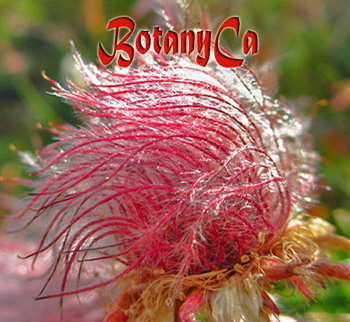
You’ll most surely see the fluffy fruit heads of the alpine pasque flower – Pulsatilla alba (syn. Pulsatilla alpina subsp. alpicola), which forms clumps of finely divided leaves and has large, white flowers, hence the name alba. There is little chance to see it in flower, because conditions are too dangerous in this area in the springtime, but the fluffy fruit heads are enjoyable enough. Loiseleuria procumbens – creeping azalea, was nearby too, so we should assume that this Pulsatilla prefers a lime-free substrate. Not very abundant in the area, scarce would be better said, is Aquilegia nigricans. In late July-August it is past its flowering time, however at high elevations one may get lucky and enjoy one last flower – deep blue, that some describe almost as black, perhaps taking into consideration its name (‘nigricans’). Like with many species growing in somewhat unusual or not too easily accessible places, some descriptions on various websites are imaginary or applied based on the copy & paste function and should be careful considered.


The descending trail follows for a while high rocky walls, adorned with various species, among which a nowadays common garden campanula: Campanula carpatica. Long taken into cultivation, it still has a particular charm when seen growing in its native ‘land’ – rocks that is. Another member of Fam. Campanulaceae, but not as widely cultivated is Phyteuma orbiculare. Does not look like bellflowers, but it is a very interesting genus with quite a few species good to grow in the rock garden. And one more species usually seen in flower from July to September is Aconithum anthora, a yellow monkshood found cultivated sometimes. The really large, showy yellow flowers are easily seen from far away – Don’t forget that it belongs to the Wolfsbane family though!   A few more species are presented in the gallery (hard to abstain :) –  I am sure Carlina acaulis would raise a few eyebrows. It’s easy to recognize the most beautiful of the thistles, called alpine or stemless thistle. It forms large rosettes with spiny leaves, usually basking in the sun and the equally large flowerhead with silvery-white ray florets is very handsome and attracts pollinators. Its roots were employed in herbal medicine as a diuretic and cold remedy.


Dianthus glacialis

Geum reptans is an alpine gem of which I was able to collect a few seeds. Growing in crevices and spreading in mats over boulders, it was already past flowering during late July, and its ornamental fluffy seed heads were getting pink. Although also admired for its yellow flowers, I find the pinnate, fernlike foliage very beautiful in itself. Called ‘the best of its race of mountain avens’ by Jim Jermyn, it is most definitely calcifuge requiring a perfectly drained mixture and full sun exposure – perfect for a scree garden.

Near the Geum reptans, small tufts of Armeria alpina stood out on top of the rocks, and then, fiercely competing with them for our attention, Dianthus glacialis, with its brilliant pink flowers, was making it very hard to concentrate on taking pictures! Dianthus glacialis in flower is a must see, at least once in a lifetime. Small green cushions covered in almost stemless pink flowers, defy description. There are two subspecies, glacialis and gelidus, the later being a Romanian endemic. The differences between them are quite minute; without going into details, subsp. gelidus has bigger flowers with a more intense pink colour, and it seems that the clumps we found belonged to this subspecies. To change the colour spectrum, clumps of two wonderful Asteraceae with white flowers: Achillea schuri and Anthemis carpatica were sprinkled on the rocky slopes, blooming profusely. Anthemis carpatica is already taken into cultivation and apparently adapts well to full sun and calcareous substrates, while Achillea schuri, endemic to Romania, has still to make its way into the gardening world.

Whenever the trail goes close to stone walls and outcrops, the delightful Campanula cochlearifolia greets you from above with its thimble-like delicate, blue flowers. It is not a pretentious plant to cultivate either, and can even overcome its boundaries if not restricted between some rocks. Among the species with violet or mauve flowers I have to mention Calamintha alpina subsp. baumgarteni (syn. Acinos alpinus subsp. alpinus). Considered a chamaephyte, it has a woody stem with small leaves and mauve flowers typical of the Lamiaceae family. On the other hand, the genus Oxytropis is not a stranger to rock gardeners, and Oxytropis halleri is a wonderful example with its violet flowers and dense pinnate foliage. And of course, it cannot be a mountain ‘story’ without a Saxifrage. Quite a few species are abounding in the Bucegi. Saxifraga paniculata seemed very happy in the Plateau, flowering in big colonies at margins of the path, as well as Saxifraga moschata, which has small rosettes, with finely divided leaves and yellow, fragrant flowers.