




This site uses cookies. By continuing to browse the site, you are agreeing to our use of cookies. See our Privacy policy.
OKWe may request cookies to be set on your device. We use cookies to let us know when you visit our websites, how you interact with us, to enrich your user experience, and to customize your relationship with our website.
Click on the different category headings to find out more. You can also change some of your preferences. Note that blocking some types of cookies may impact your experience on our websites and the services we are able to offer.
These cookies are strictly necessary to provide you with services available through our website and to use some of its features.
Because these cookies are strictly necessary to deliver the website, refusing them will have impact how our site functions. You always can block or delete cookies by changing your browser settings and force blocking all cookies on this website. But this will always prompt you to accept/refuse cookies when revisiting our site.
We fully respect if you want to refuse cookies but to avoid asking you again and again kindly allow us to store a cookie for that. You are free to opt out any time or opt in for other cookies to get a better experience. If you refuse cookies we will remove all set cookies in our domain.
We provide you with a list of stored cookies on your computer in our domain so you can check what we stored. Due to security reasons we are not able to show or modify cookies from other domains. You can check these in your browser security settings.
These cookies collect information that is used either in aggregate form to help us understand how our website is being used or how effective our marketing campaigns are, or to help us customize our website and application for you in order to enhance your experience.
If you do not want that we track your visit to our site you can disable tracking in your browser here:
We also use different external services like Google Webfonts, Google Maps, and external Video providers. Since these providers may collect personal data like your IP address we allow you to block them here. Please be aware that this might heavily reduce the functionality and appearance of our site. Changes will take effect once you reload the page.
Google Webfont Settings:
Google Map Settings:
Google reCaptcha Settings:
Vimeo and Youtube video embeds:
The following cookies are also needed - You can choose if you want to allow them:
Back to basics – Aquilegia
Plant portraits, PropagationMost probably the first plant I grew successfully from seeds (that is, which I saw it flowering :) was an Aquilegia. I don’t remember precisely which one and it doesn’t matter; I like them all very much. They are easy to grow, provide a whole array of heights/colours and are good pollinator plants.
Yes, some are short lived, and yes, most will be attacked by leafminer, and of course, they hybridize and not all seedlings come true to the mother plant, but I still like them very much.
Aquilegia flabellata var. pumila has few of the above mentioned flaws: it usually comes true from seeds, and the thick, leathery foliage won’t be affected by the leafminer (or very weak attack); all ‘flabellatas’ could be grown just for their handsome, fan-shaped foliage.
Aquilegia flabellata var.pumila – cute as a ‘button’ ; grown from seeds of course
A. flabelata ‘Nana Alba’ will be flowering soon…
Update – and it did, not a ‘nana’ but very beautiful!
Lost in translation – updates on germination requirements
Propagation, Wildflowers of North AmericaSlowly, as I have the chance to try more species myself, and/or find reliable info, I work on making updates for the germination requirements on the Seeds shop. I already mentioned about Sanguinaria canadensis.
It is easy to ‘get lost in translation’ when reading about various types of morphophysiological dormancies, but a short summary for species from temperate regions that require warm/cold cycle for germination will be as follows:
This dormancy breaking requirement is naturally fulfilled by summer (high temperatures) followed by fall (lower warm temperatures) and winter (cold stratification). Note the need of high followed by low(er) warm temperatures.
Because of the collecting/shop logistics and peoples habit of buying seeds in late fall, this means that such species, when sowed in late fall/winter will need the whole next season to undergo these requirements, although otherwise they would not qualify in the ‘2 year germinators’ category.
So it goes: changed from require ‘cold stratification’ to ‘warm – cold stratification’:
Hydrophyllum virginianum
Hydrophyllum canadense
Aralia racemosa
Prosartes lanuginosa (moist packed seeds available this fall I hope)
Ilex verticillata
Hydrophyllum virginianum seedlings, seed sown fall 2015, too late for the warm treatment, germinated this spring (2017)
Prosartes lanuginosa: seeds sown after collecting in early September 2016 – germination right now (I only had about 9 seeds)
Other warm/cold germinators that we already know about and I already posted pictures (many require moist storage): most Corydalis, Allium tricoccum, Asarum canadense and europaeum, Saruma, Anemone quinquefolia and A. nemorosa, Dicentra (D. formosa in the featured image), Thalictrum thalictroides, Jeffersonia, Hepatica….
Corydalis nobilis seedlings
Simplicity – Geum triflorum
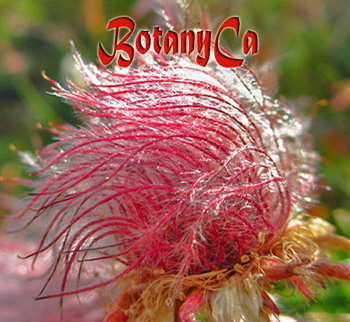
Propagation, Wildflowers of North AmericaEasy to grow in the garden and from seeds, this North American Geum is an absolute a delight! An unpretentious, care free plant in most locations; sun and good drainage required. Best when planted in large numbers for the ‘smoky’ effect of the feathery seed heads (Prairie Smoke ;) in the summer.
Geum triflorum – Prairie Smoke, Old Man’s wiskers; rosy-red, nodding calyces/flowers, followed by feathery seed heads; the compact, ferny looking foliage will become reddish in the fall.
Propagation from seeds: I did a whole bunch last year – sown in the fall and left outside (cold/moist stratification) and the germination was excellent; I planted the seedlings in the garden by late fall.
The grown up clumps can be easily divided every few years.
Note: Other sources indicate sowing at warm.
Geum triflorum seeds head
The thing about Sanguinaria
Propagation…is that the seeds can have two types of morphophysiological dormancy (after Baskin & Baskin):
Sanguinaria canadensis: seeds sown in summer 2016 – complete germination April 2017
Sanguinaria canadensis: seeds sown in late summer 2015 – complete germination in 2017
The lots of seeds shown were collected from different sites, and I wonder if this was also a decisive/only factor in displaying the different types of dormancy. It is well known that the germination dormancy traits have a genetic component.
Temperatures in the summer/winter may also have role; to be sure I will try to repeat the sowing with seeds of both populations/at the same time. It would be nice to know and collect seeds from certain populations knowing they will germinate in the first year after sowing.
Note: To be clear, for Sanguinaria we are only talking about fresh/or moist kept seeds.
Out in the woods – Hepatica
Wildflowers of North AmericaIt is that time of year when Hepaticas are flowering in the woods (and in the garden). Scouting in areas with large populations always leads to finding interesting forms!
The Hepatica acutiloba specimens shown below are isolated clumps and there is a good chance that a good proportion of the seedlings to come true to the mother-plants.
Hepatica acutiloba 1 – 2017
Hepatica acutiloba 2 – 2017
As well, this is the first find of a Hepatica americana with true pink flowers
Hepatica americana pink – 2017
Semi-double forms are not that rare as the pink flowered, but still a nice find.
Hepatica americana sd- 2017
The Hepatica shop section will be updated as soon as we’ll be able to tell how the seed forming is going on.
Also Claytonia virginica is in flower and soon Sanguinaria canadensis….a kind reminder that the Pre-orders page is up and running!
Usually there are plenty of Sanguinaria seeds and they keep well in moist storage, but asking for seeds of Claytonia, Erythronium and some of the special forms of Hepatica late in the fall, can only lead to disappointment…
Stress relief – Rhodiola sachalinensis
PropagationNothing is better for stress relief than sowing or transplanting seedlings. More than this, I had the perfect seedlings for the purpose – of Rhodiola sachalinensis.
Rhodiola sachalinensis and other Rhodiola species, particularly R. rosea, have long been used as traditional medicinal plants in Asia and Eastern Europe for various ailments, and they have been categorized as adaptogen plants, similar to the better known ginseng species. Besides this, they make for excellent rock garden plants.
Rhodiola sachalinensis grows wild in the mountainous regions of China, Japan, Korea and Russia (Altai region). Unfortunately, it is a dioecious species and the ones that survived from a batch of seedlings started 2 years ago, turned out to be all male plants at flowering.
So, I sowed a few more seeds and I will keep all the transplanted seedlings hoping that at least one will be female. Some were a bit more robust and already showed the nice, thickened caudex; I couldn’t abstain taking a picture:
Rhodiola sachalinensis seedlings
Rhodiola semenovii will have to wait to be sown next year, and I don’t have a picture of it, but here it is Rhodiola rosea in its wild habitat (Carpathian Mts.)
Rhodiola rosea
Intention – Podophyllum delavayi
PropagationMy intention was to write a longer post detailing the germination/seedlings growing of a few Chinese Podophyllum species, but by the time the evening came the desire to do that has vanished.
As a proof of my good faith I will let you admire last year’s Podophyllum delavayi seedlings. Last year by this time they were like this:
Podophyllum delavayi seedling, March 24/2016
And today, when I ‘performed’ an emergency repotting, like this:
Podophyllum delavayi – one year old ‘seedlings’ sharing the same pot
Podophyllum delavayi one-year old – showing extensive root system
It was a good intention though…
Friday’s Seeds – Tiger Iris
Friday's Seed(s)A few new Iris seeds from the rare side, so pictures are warranted. Despite its name, Iris tigridia (common name Tiger iris) is a completely harmless iris ;) hailing from the Altai region of Russia, Kazakhstan, Mongolia and China. Not an easy one, but extremely beautiful dwarf iris with blue streaked petals.
Images in wild habitat: Iris tigridia
Iris tigridia seeds
Iris potaninii, similar in habit (and distribution), has light to deep yellow flowers. As well from dry, rocky mountain slopes.
Images in wild habitat: Iris potaninii
Iris potaninii seeds
They both belong to the group of arillate Irises; I will update this post later with soaked seeds images to better observe the arils.
Snowflakes by design: Mitella diphylla
Plant portraits, Wildflowers of North AmericaThe genus name Mitella comes from the Greek ‘mitra’= cap and the common name bishop’s cap or mitrewort refers to the cap-shaped fruit.
Myriads of Mitella diphylla flowers are still falling from the sky; I mean snowflakes of course. Not too many people are familiar with this dainty North American woodlander; what a pity…
It can be found growing in deciduous woodlands in part shaded areas, most often at the edges of the forest. It is easily noticeable despite its small flowers, somewhere at the beginning of May. A better timetable is to consider that it flowers at the same time with Trillium grandiflorum, Uvularia grandiflora and Coptis trifolia.
Mitella diphylla, Two-leaved bishop’s cap (Fam. Saxifragaceae) – Tall flowering stems carrying small, fringed, snowflakes shaped flowers above a pair of leaves. Fruits are dehiscent capsules with many small, black seeds.
Mitella is not an easy subject to capture on camera
What I like even more about Mitella is that the basal leaves are evergreen; a most useful character in our climate with long flowerless periods. I cannot take a picture in the garden right now, but I have one from the previous garden showing it together with Cyclamen hederifolium and Hepatica in late November.
Mitella diphylla, Cyclamen and Hepatica foliage in November
Propagation: very easy from seeds (sown in the fall). My seedlings have started to flower in the third year. After it gets established it can also be divided (it forms a rather tight clump so there is no worry about potential invasiveness).
Mitella diphylla seeds
Friday’s Seeds – Papaveraceae
Friday's Seed(s)Back to seeds, and just a few here from the last published seed gallery.
Many of the species of Papaveraceae family present seeds with elaiosomes, a well-known adaptation to ant dispersal (myrmechory). In the general term ‘elaiosomes’ are included various seed appendages rich in lipids (with oleic acid as the main component), amino acids, carbohydrates and vitamins.
These appendages are often very beautiful and interesting. Problem is, you have to be fast in admiration because few days after dispersal/collecting (whichever comes first ;-) they will ‘shrink’ or simply ‘disappear’. This applies as well for the seeds which are kept in moist storage for later sowing/sales (keeping these species as dry seeds is strongly NOT recommended).
Stylophorum diphyllum, one of my favourites, with ‘mohawk-style’ elaiosomes (insert with seeds in moist storage).
Stylophorum diphyllum
Stylophorum lasiocarpum – with a different ‘hair’ style.
Stylophorum lasiocarpum
Corydalis solida – displays ‘leaf shaped’ elaiosomes.
Corydalis solida
Dicentra cucullaria – a hard one to catch and the elaiosomes fade very fast.
Dicentra cucullaria
And, I cannot forget the Sanguinaria: ‘little snails’ trying to get away :)
Sanguinaria canadensis
More on the Papaveraceae seed gallery.
All over again
PropagationThe first Arisaema of the season – in love all over again…
Arisaema fargesii seedling
Through the looking-glass: Montreal Botanical Garden
Botanical travelsEvery time I visit a Botanical Garden, it feels like stepping into a parallel world full of wonders. Montreal Botanical Garden especially felt like the Garden of Live Flowers. Did the flowers think that I was one of them? I don’t know, but let’s see what’s on the other side of the mirror.
Maybe not enough time to do a full exploration, but we can always return for more ;-) There are 10 exhibition greenhouses and about 30 thematic outdoor gardens!!!
Link to – Montreal Botanical Garden
Very short, I have to mention that MBG came into being in 1931 through the efforts and vision of botanist Frѐre Marie Victorin, which practically dedicated his life to this garden. Rightly so, today he welcomes all visitors at the entrance.
In the pictures: Frere Marie Victorin, and second, an archive image with him and the garden’s designer, Henry Teuscher (1936) – please click to open the full size images in the gallery.
Frere Marie Victorin – MBG
Frere Marie Victorin and Henry Teuscher in the greenhouse (1936)
Because it is cold, snowy and I had a bad cold, there is no other place I’d rather be right now than the Rainforest section of the Conservatory where it is warm and humid, and epiphytic plants and lianas are draping over the skilfully built ‘cork trees’.
Tropical Rainforest Greenhouse at Montreal Botanical Garden
Before starting to admire the multitude of species growing here, it’s good to note how much effort went into creating an environment that mimics very well the wild habitats of the displayed species, in this case many epiphytic bromeliaceae, Tillandsia, various aroids, Orchids, Maranthaceae, Zingiberaceae and Nepenthaceae.
Aechmea gamosepala and Vriesea sucrei from Brasil
As you can see from the close-up image, pieces of cork (bark of Quercus suber, I think) were skillfully arranged and tied over ‘skeletons’ of trees (made from metallic tubes). In this way, were created various levels on which species from many parts of the world could coexist harmoniously according with their light requirements.
As well, panels with the same cork supporting epiphytic Tillandsia and orchid species hanged around the sides of the greenhouse and helped to achieve a tri-dimensional look of the indoor forest.
Tillandsia andreana (Colombia)
And a bit more :)
Tillandsia xerographica
Vriesia ‘Kiwi Sunset’
Epiphytic orchids
Billbergia, Aechmea
Neoregelia
Tacca
aroid
x Canmea
Hymenocallis littoralis