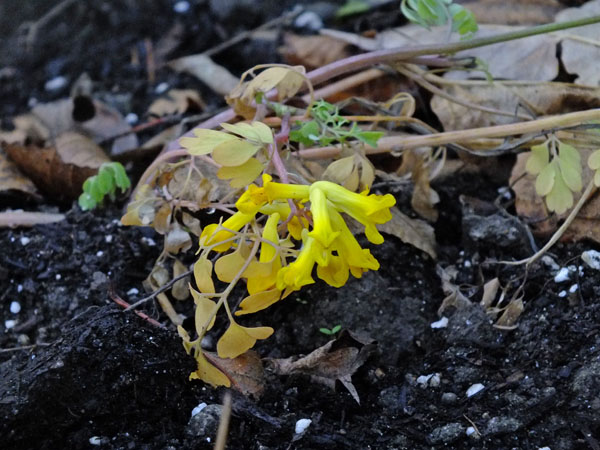
C. lutea - November

Only a short note for this month’s end because I think Corydalis lutea (syn. Pseudofumaria lutea) deserves a special mention.
Transplanted during the summer in a crowded container where it lived for quite a while, made the trip to a new place, was dug & planted in the ground, not only it flowered continuously and provided food for pollinators and quite a few seeds, but it is still in flower today (featured image), after the last weekend’s temperature low of -9˚C (with snow cover).

It has shown up from seeds by itself in the spring, like it often happens, but I think it is a bit special. More of its seeds have been spread around today, so the ‘blood’ of this warrior’ will perpetuate in the new garden :)

C. lutea -July

Corydalis lutea in container, July

mid November

In the garden last week…

Herb Paris, True lover’s Knot, Devil-in-a-bush

Renown of being hard to germinate because it requires several warm/cold cycles to break dormancy, Paris is often avoided by many people when it comes to growing it from seeds. A couple of days ago, during a check-up of the moist stored seeds, I had a big surprise. Almost all the garden collected seeds (in late summer) were already germinated! These seeds were cleaned and placed in moist vermiculite right away – an advantage of the garden collecting. Seeds that I collected in the wild and couldn’t place right away in moist storage look good but still haven’t decided to germinate.

Unless a magic trick is involved (not unusual at this time of year), cleaning the seeds after the berries are ripen and putting them right away in a bag with slightly moist vermiculite, which is the same as sowing them fresh, works very well for Paris quadrifolia.

Paris quadrifolia germinated seeds

Paris quadrifolia germinated seeds

Paris quadrifolia is a Trillium relative from moist deciduous forests of Europe and W. Asia, with a symmetric ‘constitution’ (Paris from Latin pars – equal). The four whorled leaves are topped up in early spring by a solitary, interesting flower with thread-like petals and a crown of golden stamens, followed by a deep blue berry (poisonous).

Paris quadrifolia

Paris quadrifolia

In medieval times this particular symmetry had Paris quadrifolia considered the ‘herb of equality’ and it was used in marriage rituals and as a guard against witches. It was also associated with medicine in medieval English tradition, being mentioned in Gerard’s Herbal as an antidote to toxic substances like arsenic and mercury.

According to other herbalists of the time, the black berries were also effective as a remedy for those who had lost their minds through bewitchment, or as an antidote for mental confusion due to supernatural causes :) (today it remains employed only in homeopathy).

In conclusion, for now we are safe from witches but if in the future we are to get confused, we shall use a few Paris berries…(which need “ to be administered in unequal numbers” :)))

Still flowering at this time of year, the flamboyant Indian paintbrush, Castilleja coccinea (also seeds can be collected) has one of the best common names given to a wildflower – someone must have watched the colourful leafy bracts reflecting red-orange paint strokes over the blue sky!

Castilleja coccinea

Castilleja coccinea – Indian paintbrush

Many species with seeds adapted for wind dispersal have various helping ‘devices’ (wings, hairs…). In the case of Castilleja, the seeds have a honeycomb outerlayer – nature’s design for helping with the process. The honeycomb pattern is produced by dead, air-filled cells of the single-layered seed coat.

Castilleja coccinea seedsCastilleja coccinea seeds (This is as close I could get with my camera and please ignore the debris)

Castilleja and few other Orobanchaceae present the most impressive variation of honeycomb-patterned seed coat, where both the outer and inner tangential walls are dissolved and all that remains is a loose honeycomb ‘cage’. 

About the germination:
I intend to include Castilleja in a small flower meadow, so I gather info and I shall experiment. The difficulty is to start a small population because like other hemiparasitic plants it needs its host plants to help it grow. Mostly behaves as a biennial, and in most cases if successful, it will reseed around.

Various studies had shown that C. coccinea will establish connections with the roots of a wide range of host species. It will germinate by itself but it won’t establish and grow well without a host. The best method is to sow it outdoors in the fall or spring in an area where few preferred plant host are growing (most common: little bluestem, prairie smoke, grama grass…) or in pots in combination with seeds/young seedlings of the host plants (use peat or coco-fiber pots as it dislikes transplanting).
Also, other essentials factors for good germination and survival are good moisture and surface sowing (light sensitive).

I showed at some point another beautiful Castilleja, C. applegatei var. viscida in a mountain meadow from the Wasatch Mountains.

Update after quite a few years: I once managed to have seeds germinated in a container outdoors, but the seedlings perished, in part to the squirrels digging them up.
Second attempt: a bunch of seedlings showed up after I spread a large amount of seeds into the ground (2022). I will watch with interest what happens in 2023!


Castilleja coccinea seedlings, direct sowing on the ground in late fall

And success in 2023!!!


Other Castilleja species I managed to germinate is Castilleja applegatei, sowed in late fall and provided cold/moist stratification outdoors. The seedlings vanished at some point; it may have been too much or not enough watering, hard to say. So, unfortunately I cannot add more about seedlings development.
There are also seedlings of Castilleja miniata, also germinated after cold/moist stratification.

I am sure this story will have other developments in the next years!

Maybe the title should read from now on – Wildfruits instead of flowers, although there are quite a few species still flowering. But September is announced in the woods by a multitude of coloured fruits and suddenly previously ‘invisible’ plants are suddenly highlighted, revealing their most ornamental feature. Our fall gardens would also be so poor without these colourful displays!

Aralia racemosa fruits

Aralia racemosa in wild habitat, in early September

Aralia racemosa – American spikenard is a shrubby-looking perennial which grows in moist rich woods. Cultivated, but not too often, in the past it has had various other uses (the roots): for flavoring teas, as an ingredient in root beer and medicinal. Native Americans considered the root to be a blood purifying spring tonic, and called the plant Life-of- Man; it makes sense as it belongs to the ginseng family.

Aralia racemosa foliage

Aralia racemosa in late August, cultivated

I don’t really know why but I got really excited when stumbling for the first time upon Medeola virginiana. As a result, the pictures don’t show its whole splendour revealed under the dappled shade in a moist woodsy area. Named after the sorceress Medea, there are few theories as to why Linnaeus kept this name (given to it by Gronovius) but there is no doubt that there must be sorcery involved in the way a fruiting Medeola looks.

Medeola virginiana

Medeola virginiana

The contrast made by the dark purple fruits with the red petioles and red tinged leaves (at the base) is striking and considered its most ornamental feature. Young plants resemble a bit with a Trientalis for me, or a Large leaved pogonia (Isotria verticillata) to others (I have never seen this one). Mature flowering individuals are very particular though, showing the two-tiered whorls of leaves. I think the flowers are pretty cool too, as seen in the featured image (not my picture in fact, but coming spring I know where to go now).

And the trivial: the common name, Indian cucumber-root, alludes to the fact that rhizomes have a cucumber taste/odor and were used by the Natives Americans; the plant was also supposedly used medicinally. In Canada apparently we don’t have problems with it but in the U.S.A., according to NatureServe, Medeola is listed as critically imperilled in Florida, Louisiana, and Illinois.

Either way, I think there are enough cucumbers on the market today, there is no need to dig up Medeola, which is vulnerable to harvesting and slow to propagate.

Update: I have serious doubts now that this is R. tibetica (or bhutanica) and although I had intentions I won’t add to the general confusion by offering seeds. I am waiting for other opinions regarding its identity (maybe R. australis?)…..probably it will be a looong wait.

Yesterday morning I had the wonderful surprise to find Roscoea (tibetica) in ‘labour’. The capsule was just starting to split open showing the seeds. The smallest of the genus, R. tibetica has a particular way of developing the capsule at soil level (easy to miss it), inside the stem actually, and I thought it would be interesting to show it, especially because this is also the final confirmation of its identity.

Roscoea tibetica capsule

Roscoea (tibetica) showing split capsule

Roscoea species have arilate seeds, so if ants are around (or earwigs) it’s wise not to miss the ‘delivery’. A bit of help is needed to extract the seeds without the stem being destroyed – a clean, small cut, followed by a bandage application (cheesecloth works perfectly) to secure the leftover seeds (the flowers open in succession so not all the seeds mature at the same time).

Size, shape and arils are good characters for Roscoea ID, especially considering that there is quite a bit of confusion going around – R. tibetica has seeds with deeply lacerate arils.

I presented Roscoea tibetica in the Little plants series; this year grew better in part-shade, sharing a container with A. fargesii seedlings. This is a great little Roscoea for the rock garden. Easy to grow from seeds, it can be quite variable; the form shown in the featured image has small purple flowers barely showing from among the stems, so one cannot really call it a showy plant. More than this, it starts growing sometimes in June, it flowers in late June, and by mid-August the seeds are ripen – ‘living in the fast lane’!

One for collectors and people in love with ‘little plants’ :)

Good read on Roscoea: The Genus Roscoea – Jill Cowley, RBG Kew, 2007. Speaking of which, reading again about R. tibetica and R. bhutanica, it seems that my plant fits more likely with the later: “Leaf blades usually 2-6 at flowering time, slightly auriculate… Inflorescence enclosed in leaf sheats. Flowers opening just above leaves, one open at a time…..Seed aril shallowly lacerate.”

Happy to hear other opinion…

Allium tricoccum (wild garlic, ramps)

Allium tricoccum is one of the first species to appear in early spring in the woodlands of North America. After a long winter, the onion-garlic scented, fleshy leaves look very delicious; actually they contain lots of vitamins and minerals. Leaves will completely disappear being replaced in the summer by flowering stems bearing a single inflorescence with white flowers, followed by capsules with black seeds (3 in each fruit – tricoccum). The bulbs and leaves of A. tricoccum have been traditionally used by the Native Americans, then by the European settlers and all the following generations.

Allium tricoccum spring rosette

Allium tricoccum foliage in early spring – easy to spot and smell!

Last year I didn’t collect seeds because I thought this is such a common plant around here. But I had forgotten to check the facts – it turns out that we are continuing to eat our way into the ‘future’, and what was once a very common spring sight in most North American woodlands is now rapidly fading away! Since they become more popular, with ramps festivals held annually and served in fancy restaurants as ‘local and organic’ food, they have become over-harvested everywhere.

In Quebec, wild harvesting of Allium tricoccum is currently prohibited, and in a few of the U.S.A. states it has become a ‘special concern’ species!

Allium tricoccum colony

Allium tricoccum (ramps) colony – a common spring sight (for how long?)

As it happened with other species, the regeneration doesn’t occur fast enough to keep up with the unsustainable harvesting and entire populations may disappear from one year to another.

Allium tricoccum starting to flower

Allium tricoccum flowering stems

Another notorious example of woodland species that we have managed to erase almost entirely from our woodlands through overharvesting is Hydrastis canadensis (goldenseal), and there are signs in some areas that mayapple (Podophyllum peltatum) may follow it in the near future.

Mitchella repens – Partridge berry, twinberry, squaw vine

This is also in praise of little plants because Partridge berry is a ‘ground hugger’, forming an excellent, evergreen carpet of small, rounded, shiny leaves with a whitish main vein. I can imagine it flowing over a big shaded boulder, mossy woodland humps or over a stony wall. But, sadly I have never seen it cultivated – little plants have sometimes difficulties to getting noticed…

Mitchella repens

Mitchella repens – Partridge berry, Squaw vine, in habitat

Well-known and used traditionally by the Indigenous People as a women’s herb (as an aid in menstrual complaints and childbirth, hence the name squaw vine), it was tested and still recommended by the modern herbal medicine. The ‘berries’ were also used occasionally as food.

Mitchella repens flowers

Mitchella repens flowers – pink buds opening to white, tubular, fragrant flowers with fuzzy petals (you have to lay down to notice this); they are followed by large scarlet ‘berries’ (actually drupes) which are consumed by a variety of birds and mammals in late fall.

Mitchella repens fruits

Note: The name Mitchella was chosen by C. Linnaeus to honor his friend John Mitchell. A physician, keen naturalist and cartographer; he set up practice in America and over the years provided Linnaeus with information about many North American species, partridge berry included.

Thanks to someone’s comment regarding Mitchella cultivation, I realized I should mention that it is often found growing close to Gaultheria procumbens or on top of moss mounds, which indicates its inclination for a slightly acidic substrate, besides moist locations. Give it a try! – not necessarily from seeds; the stems are easily rooting at the nodes and a small portion can be used same as a cutting (already rooted ;).

Mitchella and companions

Mitchella and companions (Gaultheria in the left-top corner)

Little plants series – the chameleon

It seems that my subscription form doesn’t always works, so I am testing with a little plant; actually from a category that should be better called ‘flat to the ground’ (or prostrate plants, botanically speaking ;) Eriogonum umbellatum (sulfur buckwheat), is well-known to the rock garden aficionados and mountain enthusiasts, and it has quite a few, hard to ID varieties.

E. umbellatum var. porteri (Porter’s sulphur flower) is the smallest of them all – a real golden nugget I acquired from Wrightman Alpines. In the wild it grows on rocky slopes and ridges at high-elevations in a few locations in Colorado, Nevada and Utah.

Eriogonum umbellatum var.porteri
Eriogonum umbellatum var. porteri – Bear in mind that this is a young plant and it needs a few more years to start glowing in its full splendour

Flat to the ground, or better said container, it is an all season interest plant: evergreen foliage with small leaves in tight rosettes, yellow bright flowers which turn red when fading (like in the featured image); the foliage will also acquire red and orange tones. Needless to say – pollinator friendly and a reliable, good companion for other little plants.

To make my point, two more images:

E. umbellatum var. aureum in full bloom in Wasatch Mts. (Utah), which is very similar with var. porteri; the later replacing var. aureum at higher elevations.

Eriogonum umbellatum var. aureum

Eriogonum umbellatum var. aureum (Wasatch Mts., Utah)

And an incredible old exemplar of E. umbellatum var. porteri which has turned red after pollination – growing at the Montreal Botanical Garden (which is renown, by the way, for its Alpine Garden).

Eriogonum umbellatum var.porteri - Montreal BG

Eriogonum umbellatum var.porteri ( Montreal BG)

Sort of a chameleonic plant I would say…

It’s in the details

Conspicuously silver-marked, pinnate leaves which are among the first to appear early in the spring:

Hydrophyllum virginianum - early spring foliage

Hydrophyllum virginianum – early spring foliage

Curled flower buds with ciliate calyces which resemble an exquisite lace work; opening to reveal white or purple bell-shaped flowers with exerted stamens:

Hydrophyllum virginianum flowers

Hydrophyllum virginianum flowers

…recognized by pollination ecologists as very valuable because they attract large numbers of native bees. They must be delicious – often foraged by the bumblebees long after their prime:

Bumblebee on Hydrophyllum virginianum

Bumblebee on Hydrophyllum virginianum

Hydrophyllum virginianum grows very well in dry, shade conditions of hardwood forests, bottomlands and edges of the woods. Excellent as a groundcover in difficult shady areas and for naturalization projects. Although considered a bit weedy, I noticed that it is not capable to compete with the non-native invasive species, which are spreading in the remnants woodlots between newly developed residential areas.

Another Hydrophyllum that will save your time (and back) from weeding in the shady, moist areas of the garden, is the Broad-leaf waterleaf – Hydrophyllum canadense.

Hydrophyllum canadense

Hydrophyllum canadense

One more garage check-up before sinking into another round of low night-time temperatures. The spring beauty seeds are sprouting! – maybe they know something that we don’t? ;)

Claytonia virginica is a true ephemeral beauty, a cheer for the soul in springtime!

Claytonia virginica

Claytonia virginica

Virginia spring beauty is common in southern and south-central Ontario and it flowers before the trees are leafing out. The pink (rarely white) flowers that are glistening in the spring sun are a treat after the long winter months! After setting seeds, it retreats in the soil for the rest of the season.

As a trial out, I sown a few seeds immediately after collecting, and I kept the rest in moist vermiculite (warm then cold). The seeds in moist storage have germinated in late December; the ones sown in the spring are germinating now. Note taken: the seeds can be safely offered for sale until beginning of December.

Claytonia virginica

On a top list of ‘hardest seeds to collect’, Claytonia comes first. I have expected Corydalis to win the prize but it didn’t. Like everything beautiful, Claytonia has proven very difficult to handle because it flowers in succession and the fruit maturation follows the same pattern, plus the fruits are dehiscent; a nightmare! And, do I need to mention the small seeds? No wonder is not on many seeds shops lists! But, a few people were happy to find these seeds available, so my effort did pay off. Plus, now I have a few seedlings for myself. Double hit!

Claytonia virginica

Claytonia virginica seedlings

After wasting time with the ceremony, I was punished to do my homework on the weekend – there are still seeds to be added in the catalogue…

I didn’t think at Syneilesis until someone who participated in the Helleborus seeds trade, asked if by any chance I have a few Syneilesis aconitifolia good seeds…There it was the warning! Indeed, if you read on various gardening forums, it will be confirmed; ‘seeds’ are set copiously but only a small amount are viable. Such a pity, considering it is a warm, easy germinator. Luckily, I was gifted, again :), a whole bunch of dry inflorescences and after sorting through all of them with patience, I was left with a few good ‘seeds’ (and a REALLY big pile of ‘fluff’).

Syneilesis aconitifolia, the shredded umbrella plant, is a great foliage plant usually grown in part-shade, but who also tolerates full sun. When grown in a rich, moist substrate it will spread to form a healthy clump, but don’t worry, there will always be someone wanting a small division of your plant. Personally, I like it most in the spring when new shoots are emerging from the ground, with the leaves covered in silky hairs – the equivalent of a fuzzy mayapple!

Syneilesis aconitifolia

Syneilesis aconitifolia emergng in early spring

They maintain the fuzziness for a little while; then after expanding, the large, ‘shredded’ leaves will make you believe they belong to another plant! The name aconitifolia, actually suggests the resemblance with an Aconitum leaf (the deeply lobed kind). Tall flowering stems erupt in the summer bearing rather insignificant flowers.
There are also mentions of Syneilesis aconitifolia being used as a medicinal plant.

Syneilesis aconitifolia foliage in May